

KAIYUE / PROFESSIONAL PRODUCTS
ATS.
Find your next part.
An automatic transfer switch (ATS) moves a load between utility and generator power in a standby system. The transfer controls check source availability before commanding a changeover. During scheduled service, inspect terminals and interlocks with power isolated, then have a qualified technician verify transfer and retransfer.
1PRODUCTS TO EXPLORE
ATS Technical Guide
Product features
An ATS for standby power connects the load to one source at a time. Rated voltage and current, pole arrangement and the transfer mechanism are the key attributes to check.
How it works
Source supervision detects loss and return of utility power. The transfer mechanism moves the load when the alternate source meets the system's acceptance criteria and the required delay expires.
Troubleshooting
If the set runs but the load stays on utility, review source availability indicators, transfer delays and position feedback. Check whether manual mode or a transfer inhibit is active.
Replacement options
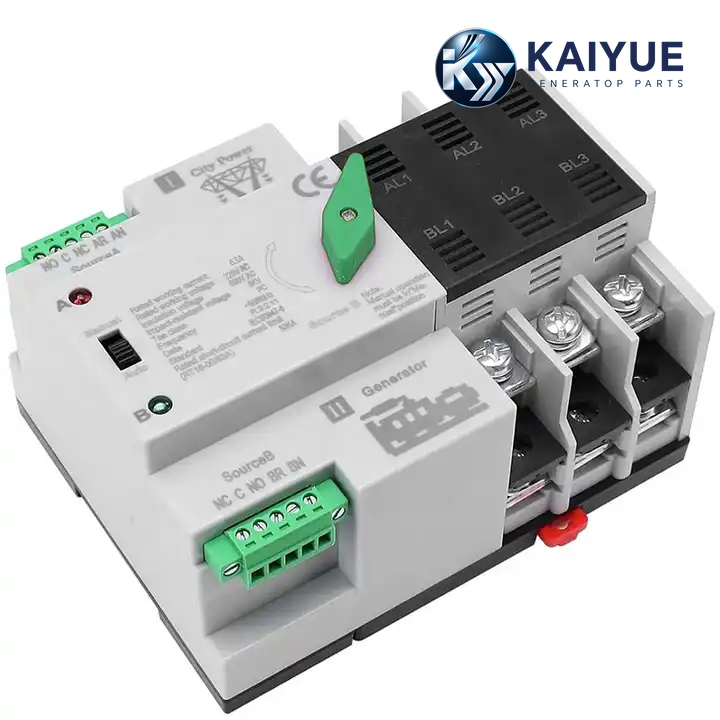
The catalog lists a three-phase DIN-rail ATS. Check the exact current rating, wiring scheme and neutral requirements against your panel documentation.
How to replace it
Have an electrician isolate utility and generator feeds and disable automatic start. Use the approved wiring diagram and verify source interlocking, transfer and retransfer during commissioning.
PRODUCT GUIDANCE
Frequently asked questions
ATS guidance for selection, use and purchasing.
Explore more FAQs ↗What is an ATS in a generator system?+
An automatic transfer switch transfers the load between available power sources. Engine-start signalling depends on the switch controller and wiring arrangement. Send the exact model and terminal diagram so our team can confirm the required functions.
View this answer in FAQs ↗How do I choose the correct ATS current rating?+
Select the rating using the installation design, continuous load, load characteristics, poles, voltage and required short-circuit performance. Motor starting and other transient loads need a model-specific assessment; they should not be treated as a universal current allowance. Send your single-line diagram and load information for review.
View this answer in FAQs ↗What is the difference between an ATS and a manual changeover switch?+
A manual changeover switch requires an operator to move the load from one source to the other. An ATS performs the detection and transfer automatically, which shortens downtime for standby and emergency applications.
View this answer in FAQs ↗How many poles does my ATS need?+
Pole count depends on whether the neutral is switched and on the earthing arrangement used in the installation. Three-pole and four-pole configurations are both common; confirm which version suits your system — confirm the specification with our team.
View this answer in FAQs ↗Can an ATS work with any generator controller?+
Many controllers provide a start signal and status contacts that an ATS can use, but the wiring interface and signal type must match. Share your controller model and the ATS terminal layout for confirmation — confirm the specification with our team.
View this answer in FAQs ↗What transfer time should I expect?+
Transfer time depends on the ATS design, the generator start-up sequence and any programmed delay. Confirm the adjustable timer ranges for the specific unit you are considering — confirm the specification with our team.
View this answer in FAQs ↗Why does my ATS fail to transfer back to utility power?+
Common causes include an unstable utility signal, incorrect voltage-sensing settings, a faulty control board or an interlock that has not reset. Check the control-circuit voltage and the sensing settings before replacing hardware.
View this answer in FAQs ↗Do I need an ATS for a prime-power generator?+
Prime-power installations without a utility connection may not need a transfer switch at all. An ATS is mainly used where a second source exists and the load must change over automatically.
View this answer in FAQs ↗What information should I send to get the right ATS?+
Send the rated current, system voltage and frequency, number of poles, control-voltage requirement, enclosure needs and the generator controller model. Photos of the existing unit and its nameplate help the review.
View this answer in FAQs ↗Is the ATS suitable for outdoor installation?+
Outdoor use depends on the enclosure protection rating and environmental limits of the specific product. Request the enclosure rating and operating temperature range for the model you intend to use — confirm the specification with our team. ---
View this answer in FAQs ↗Guidance varies by model and installation. Confirm specifications and suitability for your selected part with our team.
Not sure which part you need?
Send a model number, reference photo or application details to our team.
