

KAIYUE / PROFESSIONAL PRODUCTS
Kutai AVR Series.
Find your next part.
Kutai AVR Series regulators maintain output voltage in compatible alternators by varying excitation in response to voltage feedback. During routine inspection, check the sensing harness and field terminals for corrosion. Before ordering, match the exact model, excitation arrangement and any remote voltage adjustment connections to the original wiring.
1PRODUCTS TO EXPLORE
Kutai AVR Series Technical Guide
Product features
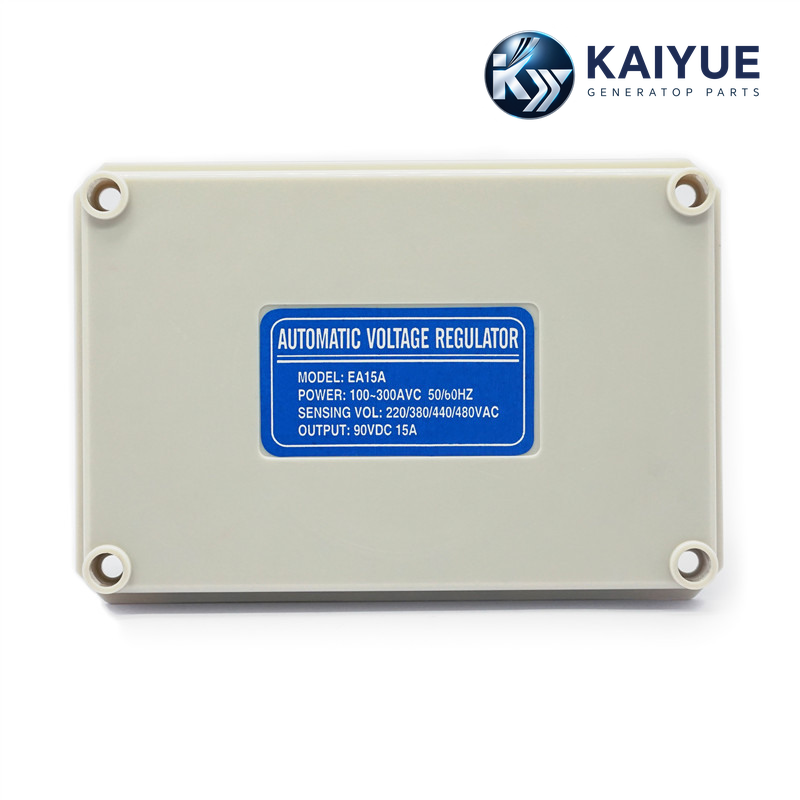
The Kutai AVR Series lists the EA15A. Compare the part reference, output and input wiring and any remote-control connections shown for the actual installation.
How it works
The AVR regulates terminal voltage by varying field drive in proportion to the difference between sensed output and the configured reference.
Troubleshooting
If voltage drifts, examine the sensing connections and any remote voltage adjuster circuit, then compare the excitation supply against the model documentation.
Replacement options
Use the EA15A as a catalog reference and confirm the alternator's field and sensing requirements along with the configured accessories.
How to replace it
Isolate the genset and record all lead positions, including auxiliary inputs if fitted. Have the technician verify setpoint and stability using the model manual.
PRODUCT GUIDANCE
Frequently asked questions
Kutai AVR Series guidance for selection, use and purchasing.
Explore more FAQs ↗What applications use Kutai AVRs?+
They are used on brushless alternators requiring an external regulator with compatible sensing and excitation characteristics. Confirm your alternator match — confirm the specification with our team.
View this answer in FAQs ↗How do I select between models in this series?+
Selection depends on sensing voltage, excitation output capability, phase configuration and required functions. Compare these against your alternator specification — confirm the specification with our team.
View this answer in FAQs ↗Can I use this AVR for a three-phase sensing application?+
Some models support three-phase sensing while others use single-phase. Confirm the sensing configuration for your chosen model — confirm the specification with our team.
View this answer in FAQs ↗What happens when frequency drops during a load step?+
On AVRs with under-frequency roll-off, a fall in frequency can cause the regulator to reduce excitation or output voltage. This is different from a controller shutdown or breaker trip. Confirm the protection functions and settings for the exact AVR and control system.
View this answer in FAQs ↗How do I adjust voltage droop for parallel operation?+
Droop adjustment is available on regulators designed for parallel operation and usually requires a current transformer. Confirm whether your model supports droop and what CT is needed — confirm the specification with our team.
View this answer in FAQs ↗What causes AVR LED fault indication?+
Indicator meaning differs per model and may signal protection operation or an internal fault. Consult the documentation for your exact reference — confirm the specification with our team.
View this answer in FAQs ↗Can I install this regulator outdoors?+
Regulators should be installed inside a suitable enclosure protecting against moisture, dust and vibration. Confirm the environmental limits of the model — confirm the specification with our team.
View this answer in FAQs ↗Why is excitation current higher than expected?+
Higher excitation can indicate a loaded or faulty rotor circuit, shorted diodes, or a sensing error causing the regulator to over-excite. Investigate the excitation path before continuing operation.
View this answer in FAQs ↗How do I confirm the AVR is healthy before a site visit?+
Record no-load voltage, frequency, excitation voltage and any indicator status. These readings help identify whether the fault is regulation or excitation hardware.
View this answer in FAQs ↗What details are needed to order?+
Provide the regulator model, alternator model, rated voltage and frequency, sensing configuration, quantity and installation photos. ---
View this answer in FAQs ↗Guidance varies by model and installation. Confirm specifications and suitability for your selected part with our team.
Not sure which part you need?
Send a model number, reference photo or application details to our team.
